Product Details
Category:
Non Bulk Products
Pack Size:
1 Kg & 4 Kg.
Non Bulk Products
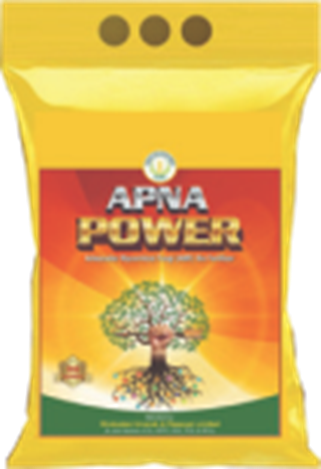
Apna Power (Mycorrhizal Biofertilizer)
★Specifications
| S.No. | Particulars | Specification / Limit |
|---|---|---|
| 1 | Total viable spores/gram of product | Minimum 10 viable spore per gram of finished product |
| 2 | pH | 5.0-7.0 |
| 3 | Inocculum potential | 1200 IP per gram of finished product by MPN method with 10 fold dilution. |
➤Benefits
›
1. Enhanced Nutrient Uptake
›
- Mycorrhizal fungi form a symbiotic relationship with plant roots, extending their reach and improving the absorption of phosphorus, nitrogen, zinc, and other micronutrients.
›
- Reduces dependency on chemical fertilizers.
›
2. Improved Soil Health
›
- Enhances soil structure by promoting aggregate stability, reducing erosion, and increasing water retention.
›
- Boosts microbial activity, leading to healthier and more fertile soil.
›
3. Drought Resistance
›
- The fungal network helps plants access water from deeper soil layers, making crops more resistant to drought and water stress.
›
4. Stronger Root Development
›
- Encourages deeper and more extensive root systems, leading to better plant growth and higher yields.
›
5. Eco-Friendly & Sustainable Farming
›
- Reduces the need for synthetic fertilizers, minimizing environmental pollution.
›
- Supports organic farming and sustainable agricultural practices.
›
6. Increased Crop Yield & Quality
›
- Studies show that mycorrhizal inoculation can lead to higher crop yields and improved produce quality.
›
7. Disease Resistance
›
- Helps plants develop natural resistance against soil-borne pathogens like fungi and nematodes.
›
8. Cost-Effective Solution
›
- Reduces fertilizer costs over time while improving long-term soil fertility.
›
9. Compatible with Various Crops
›
- Suitable for a wide range of crops, including cereals, pulses, vegetables, fruits, and plantation crops.
›
10. Easy to Use
›
- Can be applied via seed treatment, soil application, or seedling dip, making it convenient for farmers.
➤Dosage 4-6 kg/acre.
Note:The recommended dosage should be based on the analysis report of the soil test.

Urvarak Mitra
● Online – Ask me anything!
Urea for wheat
PM Kisan scheme
About HURL
Soil health card
Jobs at HURL